ARGENTINA · INDEPENDENT TRAVEL GUIDE
Museo Naval de la Nación in Tigre
At 602 Paseo Victorica, on the banks of the Luján, you can stand beside the boat that carried Vito Dumas around the world. In the same gallery are the surviving remains of a frigate commanded by Admiral Guillermo Brown. One gives you the dimensions of a solitary sailor’s world. The other asks you to imagine a whole vessel from just a fragment. They make a good starting point for a visit to Argentina’s national naval museum.
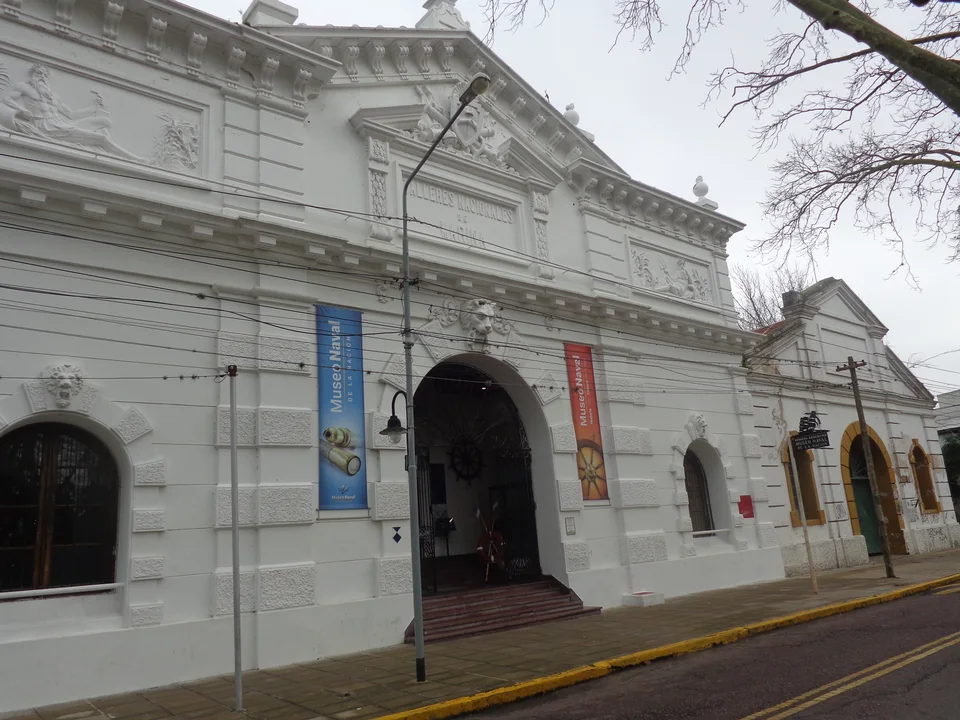
The workshops were here before the museum
In 1880 President Nicolás Avellaneda ordered the construction of facilities to support the squadron established under Sarmiento. The national naval workshops at Tigre and their counterparts at Zárate were among the Argentine navy’s first arsenals. The Tigre site later served as a technical school, a base for torpedo boats and a place to store artillery. Before you go in, take a look at how close the workshops stood to the water. For a fleet needing repairs, the river was the way in.
The museum itself dates from 1892, when the Centro Naval founded it. The Ministry of the Navy later took it on. As the collections grew, so did their need for space. They finally moved to Tigre in the 1940s. By the time anyone came here to see a museum exhibit, the buildings already had more than half a century of working history behind them.
Two very different voyages in the Manuel Belgrano gallery
Look for Vito Dumas’s sailing boat. He left Buenos Aires in 1942 and reached Argentine waters again in 1943 after rounding Cape Horn. Mar del Plata was his first Argentine port on the return journey. Standing beside the hull gives you a sense of something that a photograph can hardly convey. All the space one sailor had to live and work between ports fits into a single glance.
Nearby are the archaeological remains of Brown’s frigate, the 25 de Mayo. Read the object label first and try to pick out a feature you can recognise in the fragment. The museum’s scale models offer a different way of looking. Its collection ranges from fishing boats and merchant ships to sporting craft and warships. Compare the working deck of one vessel with that of another built for a different purpose.
Following the history through the galleries
The Independencia gallery begins with the British invasions of the Río de la Plata. González Lonzieme takes Argentina’s maritime history up to 1880, while Ratto follows the subsequent development of the navy. The arms gallery has a section on the 1982 Falklands or Malvinas conflict. For a change of scale, there is an outdoor artillery and aviation park. In wet weather you can spend the visit indoors and decide about the park on your way out.
- Armada Argentina · Museo Naval de la Nación
- Ministerio de Defensa · Historia del edificio
- Viví Tigre · Museo Naval de la Nación
- Club Náutico Mar del Plata · De cara al mar